
Do You Need a Permit to Build a Pond in Alabama?
Often, no. Alabama has no state dam safety program. The rules that can apply come from TVA, the Corps of Engineers, ADEM and your city or county, and the site decides which ones.
A few questions settle it. Does the pond dam or fill a creek, and does that creek drain to the Tennessee River? Does the site sit in a wetland or a mapped flood zone? Will the job disturb an acre or more of ground?
Take a small pond dug in a dry pasture outside city limits, away from creeks, wet ground and flood zones. It may need nothing more than a free Alabama 811 locate request. Here is each rule, who to ask and where our pond construction work fits.
| Rule | When it applies | Who to ask |
|---|---|---|
| Section 26a approval | A dam, fill or other obstruction along or in the Tennessee River or a tributary | TVA |
| Section 404 permit | Dredged or fill material in a stream or wetland not covered by the farm pond exemption | US Army Corps of Engineers |
| Construction stormwater coverage | A site that disturbs one acre or more | ADEM |
| Flood plain permit | Construction or other development in a mapped flood zone | Your city or county |
| Locate request | Any digging, at least two to ten full working days ahead | Alabama 811 |
| Burn permit | A fire of a quarter acre or more | Alabama Forestry Commission |
Does a pond on a creek need TVA approval?
It can. TVA is the Tennessee Valley Authority, and section 26a of the TVA Act requires its approval before construction. That covers a dam or other obstruction affecting navigation, flood control or public lands. It applies along or in the Tennessee River or any of its tributaries.
The list goes past dams. TVA’s examples of obstructions include fills, water intakes, bridges and pipelines.
In the Tennessee Valley, a farm creek can be a Tennessee River tributary. Cedar Creek in Franklin County is one. Check whether your creek drains to the Tennessee River before a dam or fill goes across it. If it does, ask TVA first.
Is a farm pond exempt from a Corps of Engineers permit?
Often, yes, with a catch. Federal rules exempt the construction or maintenance of farm or stock ponds from the Corps’ Section 404 permit. The exemption names farm or stock ponds, so a pond that is not part of a farm or ranch is a question to put to the Corps.
The catch sits in the same rule. A permit is still needed when the work converts waters of the United States to a use they never had. That applies where the flow could be impaired or the reach of the water reduced. A creek or a wetland can fall under that rule.
That is why a pond that dams a creek is looked at differently than a dug pond in a pasture. Alabama Extension’s pond guide says wetlands on a pond site must be identified before construction starts. It says to check with the Corps or NRCS first to learn which law or rule applies. Sometimes a permit or added planning help is needed.
When does ADEM stormwater coverage apply to a pond?
ADEM is the state environmental agency. Its construction stormwater coverage applies to a site that will disturb one or more acres of land.
That acre is disturbed ground, and a pond job disturbs more than the water. Clearing the basin, building the bank, spreading the spoil and cutting the access all disturb dirt. A pond with an acre of water can disturb more than an acre once those are added in.
ADEM lists normal agricultural and silvicultural activities, meaning farm and forestry work, among those that need no coverage. Whether a farm pond fits that line is ADEM’s call, so ask before the work starts. Our guide to land clearing permits in Alabama covers the rest of the ADEM rule.
Do you need a flood plain permit for a pond?
Check the flood map first. Cities and counties in the National Flood Insurance Program must meet federal minimum standards. In a mapped flood zone, those standards require permits for all proposed construction and other development.
Development is a broad word there. The federal definition counts filling, grading and excavation, so digging a pond is development. A mapped flood zone is land with a 1 percent or greater chance of flooding in any given year. The zones are drawn on the community’s Flood Insurance Rate Map.
Morgan County shows how this works locally. Its county engineer’s page says flood plain permits are required for most construction in the county. The same page posts a floodplain area development permit application.
Federal rules also have the local office check that every other needed permit, Section 404 included, is in hand. Inside a city, ask the city. Outside city limits, ask the county engineer’s office.
What has to happen before the dirt moves?
Call Alabama 811 at least two to ten full working days before any digging. The service is free for all users. Digging starts only after every utility has responded.
Alabama Extension adds two checks. Make sure the pond will not violate any right-of-way agreements. If a pipeline or cable crosses the site, notify the utility company and get permission to dig before construction starts.
A wooded pond site gets cleared first. On a land clearing job, the debris gets hauled off, buried on site or burned.
Burning is the landowner’s business. The Alabama Forestry Commission requires a burn permit for a fire of a quarter acre or more. Under a quarter acre, no permit is needed.
Who plans the dam and the overflow?
Alabama has no state dam safety program, but Extension’s pond guide still opens its site advice with safety. Where possible, it says to avoid a site where failure of the dam could cause loss of life or injury. Damage to homes, industrial buildings, railroads or highways is on the same list. If the only good site carries one of those risks, Extension says to hire an engineer experienced in pond design.
Where a pond needs a designed dam or a sized overflow, that plan comes from NRCS or an engineer. We dig and shape the dirt to that plan. Your county NRCS office is the place to start.
What do we handle, and what stays with you?
We do not pull permits, and nothing on this page is legal advice. You check with the agencies, and we work inside the property lines you show us. Rules change, so confirm anything that matters with the agency that issues it.
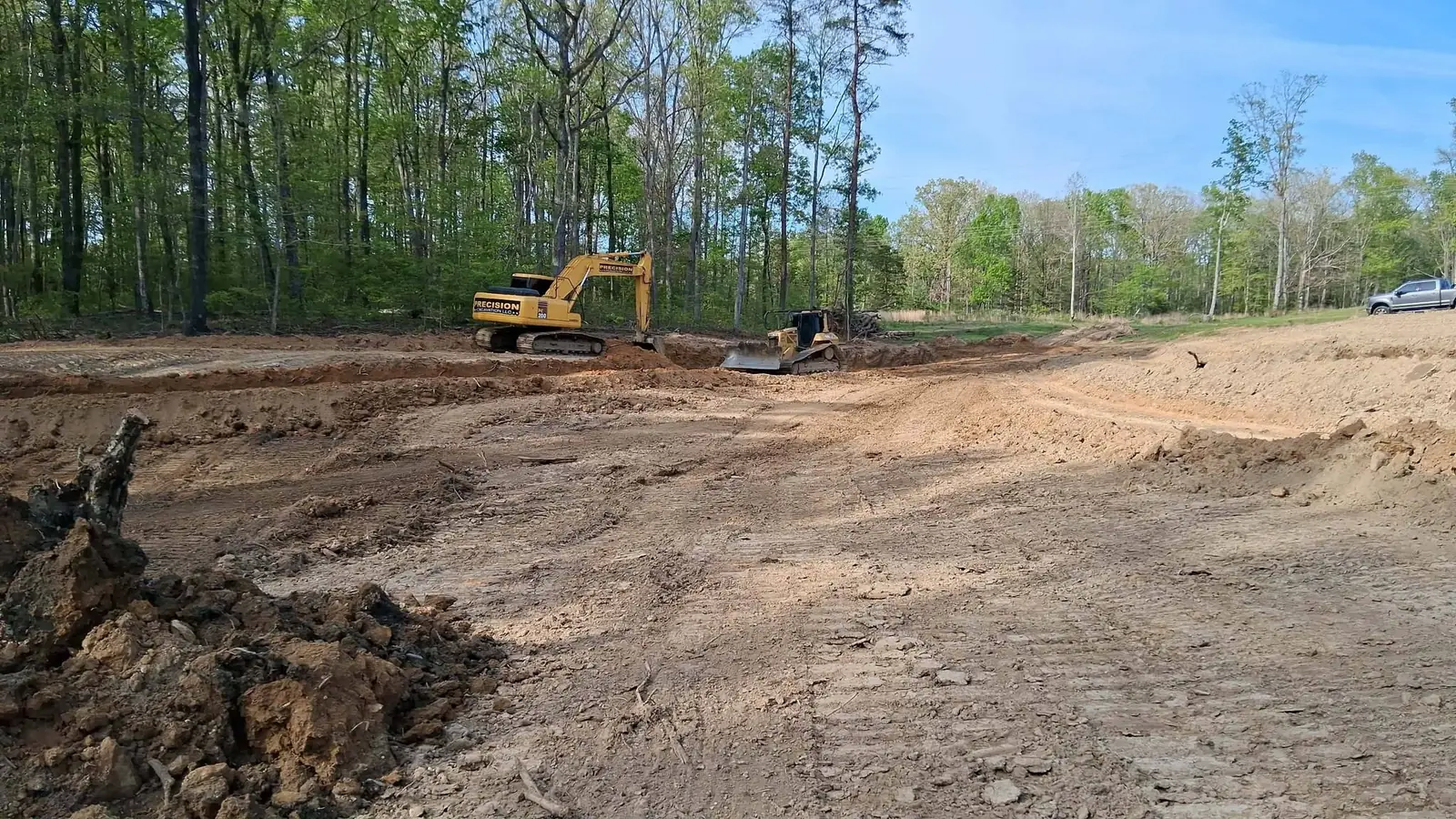
On the dig, the trackhoe cuts the basin and the dozer builds and shapes the bank. Spoil gets spread on the property or hauled off by the truckload. Where spoil fills a low spot, grading shapes it so water sheds.
For what a pond dig runs, see our guide to pond digging costs in Alabama. When your site checks out, call or text (256) 303-7210 about digging a farm pond on your place. The estimate is free.